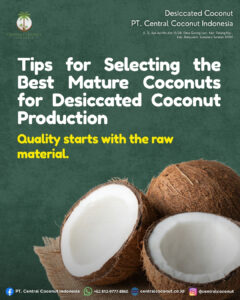
Quality in the food industry is not merely an outcome; it is a meticulously managed process that begins with the raw material. For desiccated coconut production, the selection of mature coconuts is the foundational step that determines the final product’s flavor, texture, and safety. To achieve a premium grade, manufacturers must adhere to stringent criteria throughout the supply chain.
1. Origin and Cultivation
Superior coconut quality is inherently tied to its origin. Regions such as Indonesia, the Philippines, and India remain the premier sources, leveraging optimal tropical climates, nutrient-rich soil, and established agricultural expertise to lead global production. Selecting coconuts from these regions ensures a high-quality baseline.
2. Rigorous Processing Standards
The quality of the final product is determined by the precision of its manufacturing process. Global industry compliance necessitates rigorous adherence to international standards throughout the production cycle. From de-husking and pairing (removing the brown skin) to grinding, drying, and sifting, each systematic stage is essential to achieving a premium grade that satisfies stringent technical requirements and safety protocols.
3. Moisture Control for Shelf Life
To ensure optimal consistency and an extended shelf life, desiccated coconut must maintain a strict moisture content threshold of 3% maximum. This low moisture level is critical to preventing microbial growth and maintaining the product’s crisp texture.
4. Fat Content and Chemical Stability
Adhering to international specifications, desiccated coconut is categorized by fat content:
-
High-Fat Desiccated Coconut: Should contain 60% or more oil by mass.
-
Low-Fat Desiccated Coconut: Contains less than 60% oil by mass.
Regardless of the fat content, to guarantee chemical stability and premium freshness, both varieties must strictly maintain a Free Fatty Acid (FFA) level not exceeding 0.3%.
5. Color and Sensory Characteristics
In terms of sensory characteristics, high-quality desiccated coconut is expected to exhibit a uniform creamy white or natural white coloration. This visual profile serves as a primary indicator of processing quality. Any deviation—such as yellowing or browning—typically suggests oxidation or improper thermal treatment during the drying stage.
6. Texture and Granulometry
Desiccated coconut is classified into various grades based on particle size, ranging from extra-fine to chips. Each grade is subject to specific granulometric standards. For instance, the ‘Fine’ grade requires particles to pass through a 1.40 mm sieve to ensure texture uniformity and industry compliance.
7. Certifications and Operational Integrity
Adherence to international certifications—such as BRCGS, HACCP, ISO, and Non-GMO Project—is fundamental to ensuring food safety and operational integrity. These frameworks provide a standardized assurance of quality and consistency across the global desiccated coconut supply chain.
Producing high-quality desiccated coconut requires a holistic approach, starting from sourcing mature nuts from premier tropical regions to employing precise manufacturing techniques. By strictly controlling moisture, fat content, and adhering to international sensory and safety standards, producers can guarantee a product that meets the exacting demands of the global market.
Understanding these technical specifications ensures that consumers and industrial buyers alike receive only the best product. Quality raw materials, combined with rigorous processing, are the undeniable keys to success in the desiccated coconut industry.
Briandy Effendi
Sales Executive
WhatsApp: +62 812-9777-8860 | E-Mail: sales@centralcoconut.com
Jl. Tj. Api-Api No.Km.15/24, Desa Gasing Laut, Kec. Talang Klp.,
Kab. Banyuasin, Sumatera Selatan 30961