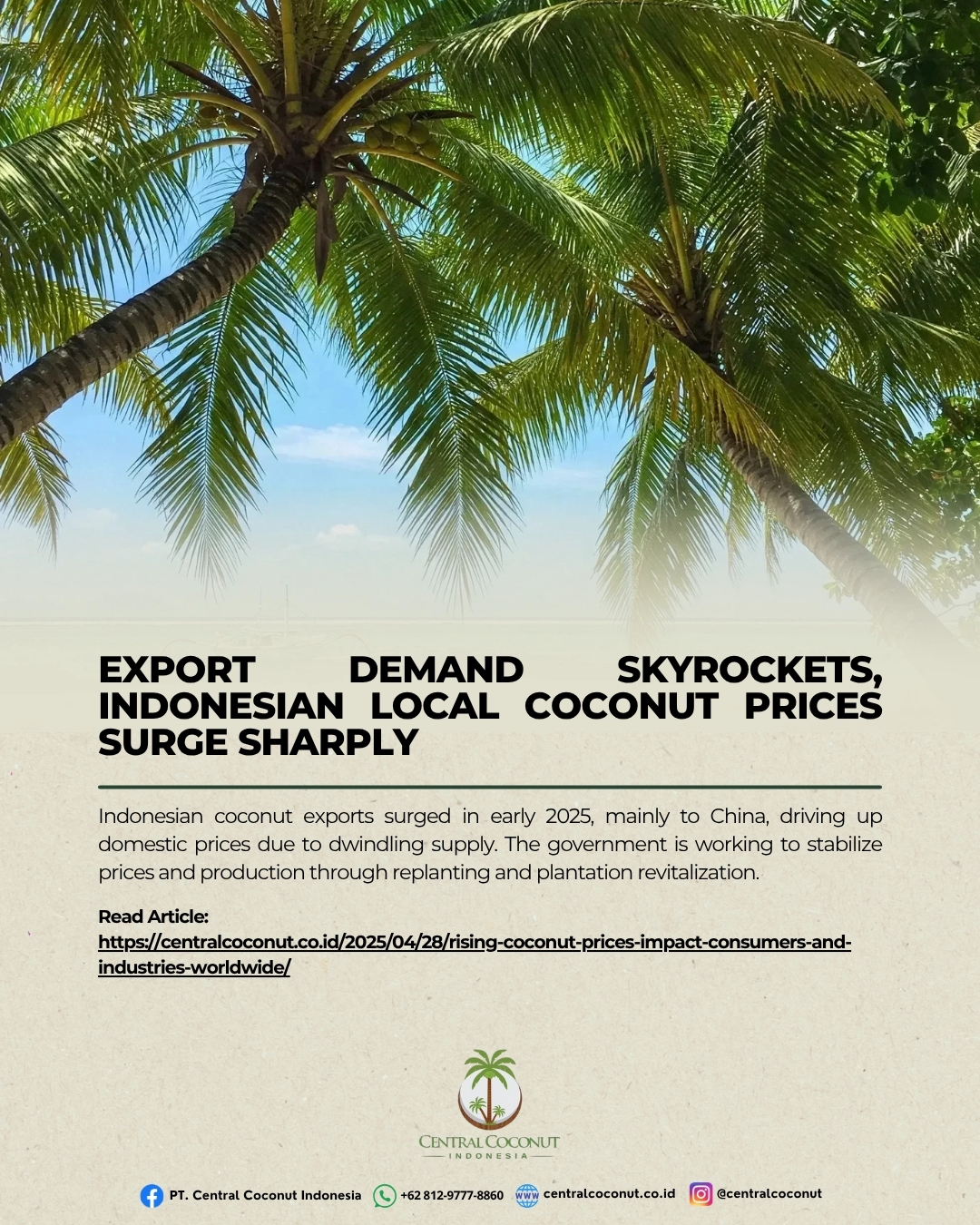
The burgeoning appetite from the international trade arena for Indonesia’s coconut produce has manifested in a notable upswing right from the outset of 2025. This escalating demand has subsequently exerted upward pressure on the pricing structure within the domestic market.
Drawing upon granular data furnished by the Indonesian Central Bureau of Statistics (BPS), the aggregate volume of whole coconut exports, encompassing those still encased in their husks, reached an impressive 431,915 metric tons throughout the entirety of 2024. This figure represents a considerable augmentation when juxtaposed with the 380,883 metric tons recorded during the preceding annual cycle, underscoring a significant year-on-year growth in export activity.
Within this dynamic export landscape, the People’s Republic of China has solidified its position as the preeminent destination for the outflow of Indonesian coconut commodities. The recorded purchase volumes from this economic powerhouse reached a substantial 68,065 metric tons in the month of February 2025 alone, translating to a considerable value of USD 29.5 million. This highlights the pivotal role of the Chinese market in absorbing Indonesia’s coconut exports.
Beyond the significant demand emanating from China, neighboring nations within the Southeast Asian bloc, specifically Vietnam, Thailand, and Malaysia, also constitute vital and substantial absorption markets for Indonesia’s exported coconut goods. Their collective import volumes contribute significantly to the overall export figures and underscore the regional importance of Indonesian coconut in the Southeast Asian supply chain.
The primary catalyst behind this heightened international demand lies in the expanding utilization of versatile coconut-derived products across an increasingly broad spectrum of global industries. This includes a surge in the incorporation of coconut ingredients within the food and beverage sector, a growing reliance on coconut oil and extracts in the burgeoning cosmetics industry, and an increasing recognition of the health and wellness benefits of various coconut products in the pharmaceutical and nutraceutical sectors. This multifaceted demand from diverse industries is fueling the overall increase in export orders.
However, this robust and intensified export activity has inadvertently led to a noticeable contraction in the availability of coconut supplies within the Indonesian domestic market. As greater volumes of coconuts are directed towards fulfilling international orders, the supply remaining for domestic consumption and processing has diminished.
This tightening of domestic supply has, in turn, exerted upward pressure on the pricing of whole coconuts at the local level. Current market prices for whole coconuts are now oscillating between IDR 25,000 and IDR 30,000 per individual fruit. This represents a rather conspicuous disparity when compared to the prevailing normal price range, which typically fluctuates between IDR 8,000 and IDR 10,000 per coconut, signifying a substantial increase in the cost of this essential commodity for domestic consumers and industries.
The esteemed Minister of Agriculture of Indonesia, Mr. Andi Amran Sulaiman, has articulated the perspective that this significant surge in coconut prices offers a tangible economic benefit to the nation’s coconut farmers, potentially enhancing their livelihoods and contributing to the agricultural sector’s overall prosperity. Nevertheless, Minister Sulaiman also underscored the critical imperative of maintaining a judicious equilibrium between the pursuit of lucrative export opportunities and the fundamental necessity of adequately fulfilling the demands of the domestic market to prevent undue hardship for local consumers and industries reliant on coconut supplies.
Informed by this intricate interplay of international demand and domestic market dynamics, the Indonesian government is formulating strategic initiatives aimed at addressing both the immediate price concerns and the long-term sustainability of the coconut industry. A key component of this strategy involves plans to accelerate the national replanting program for coconut trees, aiming to rejuvenate aging plantations and enhance overall productivity. Furthermore, there are concerted efforts to revitalize the existing coconut plantation infrastructure to optimize efficiency and output. These proactive measures are intended to augment the national coconut production capacity, thereby contributing to the stabilization of prices in the domestic market while simultaneously sustaining Indonesia’s position as a key global exporter of coconuts.
Given the confluence of escalating international demand and the resultant elevated prices in the domestic market, a collaborative approach involving all relevant stakeholders within the coconut industry – including farmers, processors, exporters, and government agencies – is deemed essential. Such synergistic efforts are crucial in ensuring the long-term viability and sustainability of Indonesia’s coconut production, safeguarding the interests of both the national economy and the livelihoods of those engaged in this vital agricultural sector.
by:
Briandy Effendi
Sales Executive
WhatsApp: +62 812-9777-8860 | E-Mail: sales@centralcoconut.co.id
Jl. Tj. Api-Api No.Km.15/24, Desa Gasing Laut, Kec. Talang Klp.,
Kab. Banyuasin, Sumatera Selatan 30961.