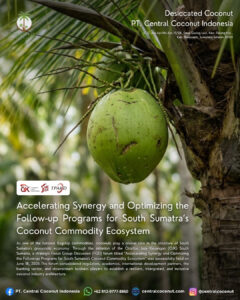
Indonesia, the world’s largest coconut producer, is currently finalizing an aggressive strategy that has the potential to skyrocket the value of its coconut commodity exports up to a hundredfold from the current figure. Minister of Agriculture, Andi Amran Sulaiman, asserted that the main key to achieving this fantastic potential of IDR 2,400 trillion—far exceeding the current export achievement of IDR 24 trillion—is through the massive and structured downstreaming (hilirisasi) of the coconut industry within the country.
For years, Indonesia’s coconut trade has been dominated by the export of raw materials or basic processed products. The downstream strategy aims to shift this paradigm to deep processing of all parts of the coconut tree. This includes not only the flesh, but also other derivative products such as coconut oil (VCO, cooking oil), husk (coco fiber), shell (activated charcoal, briquettes), and coconut water (nata de coco, beverages), all of which have a significantly higher selling value in the global market.
This move is expected to create a longer value chain, ensuring that the largest profits from this commodity remain domestically. The results are already being seen in some production centers. The Minister gave an example: in North Maluku, the price of a coconut, which was initially only IDR 600 per piece, jumped to IDR 3,500 after the processing plant began operations, with a target of reaching IDR 5,000 to IDR 6,000 per piece if the program runs optimally nationwide.
The massive investment in the plantation subsector’s downstreaming, involving various ministries and State-Owned Enterprises (BUMN), is projected to provide significant multiplier effects. In addition to increasing foreign exchange earnings, the program also focuses on:
-
Improving Farmers’ Welfare: The rise in the purchase price at the farm level will break the chain of poverty in coconut-producing regions, the majority of whom are small-scale farmers.
-
Job Creation: It is estimated that this downstream program, which includes coconut, cocoa, and other plantation commodities, will absorb over three million new jobs within the next four years, especially in the processing and supply chain sectors.
-
Strengthening Food Self-Sufficiency: This program also forms the basis for strengthening national food self-sufficiency, propelling Indonesia back into a leading role as a major player and exporter of high value-added agricultural products in the global market.
Although the potential for a 100-fold increase seems very promising, there are several structural challenges and critical questions that need to be addressed so that this ambition does not remain merely a number on paper.
1. Raw Material Availability and Tree Regeneration
The assumption that coconut raw materials are abundant needs to be critiqued. Many smallholder coconut plantations in Indonesia are old (over 50 years of age), resulting in low productivity. Downstreaming requires a consistent supply of high-quality raw materials. The big question is: Does the government have a concrete and adequately funded plan for massive and sustainable coconut replanting, which is often a major obstacle due to cost and the long time until harvest?
2. Logistics and Infrastructure
Coconut production centers are often located in remote island areas, far from processing industry hubs. Downstreaming demands high logistical efficiency to transport coconuts or semi-finished products to factories and export ports. Is the infrastructure—roads, ports, and storage facilities—in these coconut-producing areas adequate to support the potentially 100-fold increase in commodity volume? If not, high logistical costs could erode the competitiveness of Indonesian processed coconut products in the international market.
3. Economies of Scale and Farmer Integration
The success of downstreaming relies heavily on large-scale industries, yet the majority of plantations are owned by smallholders. If the processing industry is run centrally without fair integration, the risk of price exploitation at the farm level remains. The Minister has promised the involvement of small farmers in the value chain, but specific mechanisms and regulations that guarantee small farmers become strong partners, not just passive suppliers, must be clearly defined and strictly implemented.
4. Global Competitiveness and Quality Standards
The market for coconut derivative products such as VCO, activated charcoal, and briquettes already has strong players from other countries. Indonesia must not only produce but also ensure its products meet strict international quality standards. Is there sufficient investment in research, post-harvest processing technology, and certification to guarantee premium quality sustainably, which is necessary to lead the high-value product market?
Overall, the vision of achieving IDR 2,400 trillion from coconut exports shows great ambition to capitalize on Indonesia’s agricultural assets. However, the success of this target will be heavily determined by the extent to which the government can overcome classic issues surrounding plantation rejuvenation, infrastructure, and structural support for small farmers on the ground.
Briandy Effendi
Sales Executive
WhatsApp: +62 812-9777-8860 | E-Mail: sales@centralcoconut.co.id
Jl. Tj. Api-Api No.Km.15/24, Desa Gasing Laut, Kec. Talang Klp.,
Kab. Banyuasin, Sumatera Selatan 30961