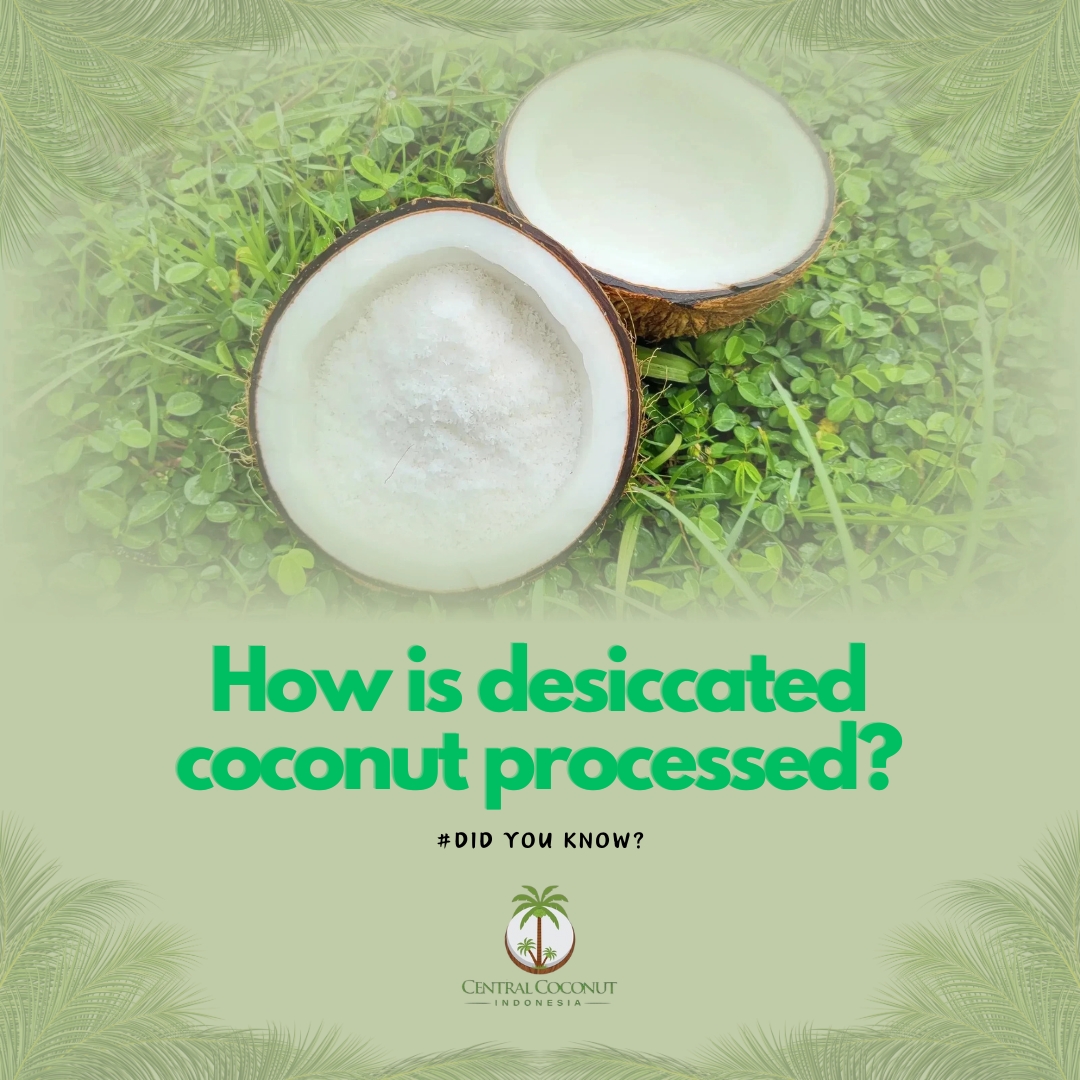
Desiccated coconut is the meat of the coconut fruit that has been finely grated, dried, and processed hygienically for food raw materials. The purpose of processing coconuts into desiccated coconut is to reduce business losses, namely by preservation by reducing its water content.
The processing of desiccated coconut typically involves the following steps:
1. Raw Material Preparation
Before being accepted at the factory, coconuts must be selected. The selection of raw materials purchased from coconut farmers for processing desiccated coconut must be mature coconuts of grade A, namely diameter (> 13.5 cm), A2 (12.5 cm – <13.5 cm), A3 (11.5 cm – <12.5 cm).
Mature coconuts of grade B with a diameter (<10.00 cm) are not accepted. Coconuts must not be germinated, the shell must not be broken, the ripeness is sufficient, the coconut shell is blackish, and coconuts with sprouts are not accepted.
2. Coconut Sorting
Coconut sorting is an important step in processing desiccated coconut to ensure the quality of the final product. Only coconuts that meet certain specifications are used, namely fresh coconuts, not germinated, with intact shells, mature, and with a blackish-brown shell color. Coconuts that meet the requirements will be processed into desiccated coconut, while coconuts that do not meet the requirements will be diverted for coconut oil processing.
3. Shelling
Whole coconuts from the shaller basket are taken to the shelling area. The coconut shells are broken using a shaller machine or a shell separator without breaking the coconut meat. This is because broken coconut meat will disrupt the next process, which is the paring (removing the brown skin). The purpose of shelling is to make the paring process easier.
4. Paring (Remove the Brown Skin)
The brown skin on the coconut is removed using a special knife, called a paring knife. The purpose of removing the brown skin is to obtain the white coconut meat.
The thickness of the white coconut meat should be 8–12 mm, and the thickness of the peeled brown skin should be a maximum of 1.60 mm. During the paring process, 12–15% of the coconut meat is also peeled off along with the brown skin.
The thickness of the peeled brown skin is measured using a micrometer (caliper). After peeling, the coconut meat is cut in half to remove the coconut water. The removed brown skin is collected and processed into coconut oil.
5. Washing and Storage
The coconut meat is washed using clean water supplied from the water treatment (WT) facility. The water from the WT is channeled onto a belt conveyor to facilitate the washing process. Then, any remaining unpeeled brown skin, shell fragments, coconut fibers, slimy coconuts, and other foreign objects are sorted out. The purpose of washing the coconut meat is to clean it from coconut debris itself, foreign objects, and to prevent discoloration. After that, the coconut meat is put into a transfer tank. The transfer tank is a temporary storage tank. The purpose of storing the coconut meat in the transfer tank is to temporarily store the material before it enters the grinder and to ensure that the raw material supply is available during production. The coconut meat is stored in the transfer tank for 1 hour. The storage capacity of coconut meat in the transfer tank is 6 tons. The transfer tank consists of 3 compartments, each compartment having a capacity of 2 tons.
6. Coconut Meat Sorting
Coconut meat from the transfer tank is then conveyed to a belt conveyor for the final sorting process. Coconut meat that does not meet specifications from the packing and storage areas is also sorted. The sorted coconut meat is transferred via a screw conveyor to the grinder for the next process, namely the grating process.
7. Grating
The grating process is carried out using a grinder. The purpose of grating is to obtain desiccated coconut (DC) with different grating sizes. The function of the grinder is to crush/reduce the size of the product according to the desired size specifications, namely medium (2.90 mm), fine (1.40 mm), extra fine (0.60 mm). To determine the grating results and differentiate between medium and fine sizes, a water test method can be used:
a. After the grinder is operated, take a sample of the grated coconut.
b. Sprinkle the sample into a stainless steel sieve under a stream of clear running water.
c. Visually analyze the sample and then determine whether it meets the medium or fine specifications.
8. SO2 Spraying
The spraying of Sodium Metabisulfite (SO2) is carried out according to the buyer’s request, with a maximum dose of 30-50 ppm. The ratio of SO2 to coconut meat is 3 kg : 6,000 kg. The SO2 is sprayed directly onto the raw material. The purpose of adding this solution is to act as a bleaching agent for the desiccated coconut (DC). The impact of an excessive SO2 dose can cause infertility, and the effect on the DC is that the color becomes dull. The impact of an insufficient SO2 dose is that the white color of the DC is not optimal.
9. Sterilization
The sterilization process is carried out using steam from a boiler at a temperature of 100-120°C for 10-15 minutes. The purpose is to deactivate microorganisms on the grated white coconut meat.
10. Drying
The drying process is one way to preserve the product so that it can last longer. The principle of drying is to reduce the water content in the material by heating it so that desiccated coconut (DC) is obtained with a water content of 1.8% – 2.9%, and microorganisms can no longer grow on the material. Drying of the DC uses a dryer machine.
The drying process in the dryer goes through three stages, namely stage A, stage B, and stage C, where each stage is given a different temperature, namely stage A: 110-135°C to reach a water content of 54%, stage B: 80-120°C to reach a water content of 30%, stage C: 70-100°C to reach a water content of 1.8%. The goal is to prevent the DC from burning, which causes the color to turn blackish brown. The drying time is 20 minutes.
11. Sifting
Sifting is the process of separating the desiccated coconut (DC) from the largest to the smallest size. The goal is to obtain the desired sizes, such as medium, fine, and extra fine. A rotex machine is used for sifting.
12. Sorting
Sorting aims to separate the desired material (DC) by removing the outer skin and other impurities. For metal impurities, magnetic bars are placed at the end of the flow to capture them.
13. Temporary Storage
Temporary product storage is done in a hopper tank before packing. The storage time is 30 minutes. Temporary storage aims to stabilize the product filling process in the brown bag.
14. Packaging
At this stage, the product is inspected by the quality body before being packed. The inspection aims to adjust standards such as color must be white, not damp, free from metal and other foreign objects. If everything is in accordance with the standards, the product is suitable for packing. After the product is packed, the product will be weighed. This weighing serves to measure the weight of the product in the bag. The weight of the product in the package: 100 lbs (45.36 kg), 55 lbs (25 kg), 50 lbs (22.68 kg), 25 lbs (11.34 kg) and 10 lbs (4.536 kg).
Packaging consists of primary packaging in the form of polyethylene plastic and secondary packaging in the form of a labeled/coded brown bag. Example: 10 – AP – F – 0000
Desiccated coconut is a versatile food product made through a multi-stage process, from selecting high-quality coconuts to careful packaging. Key factors influencing quality include coconut quality, production cleanliness, and controlled drying. Understanding these factors enables the production of high-quality, safe desiccated coconut with a smooth texture, white color, fresh aroma, and long shelf life. Ongoing innovation in machinery, drying methods, and quality control further enhance production efficiency and quality, ensuring desiccated coconut remains a valuable and globally popular product.
Contact Us
Phone: (+62) 711-2010-218
E-Mail: sales@centralcoconut.co.id
Jl. Tj. Api-Api No.Km.15/24, Desa Gasing Laut,
Kec. Talang Klp., Kab. Banyuasin, Sumatera Selatan 30961