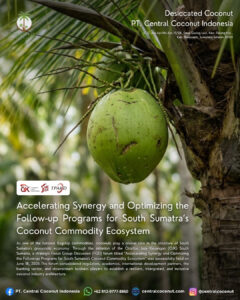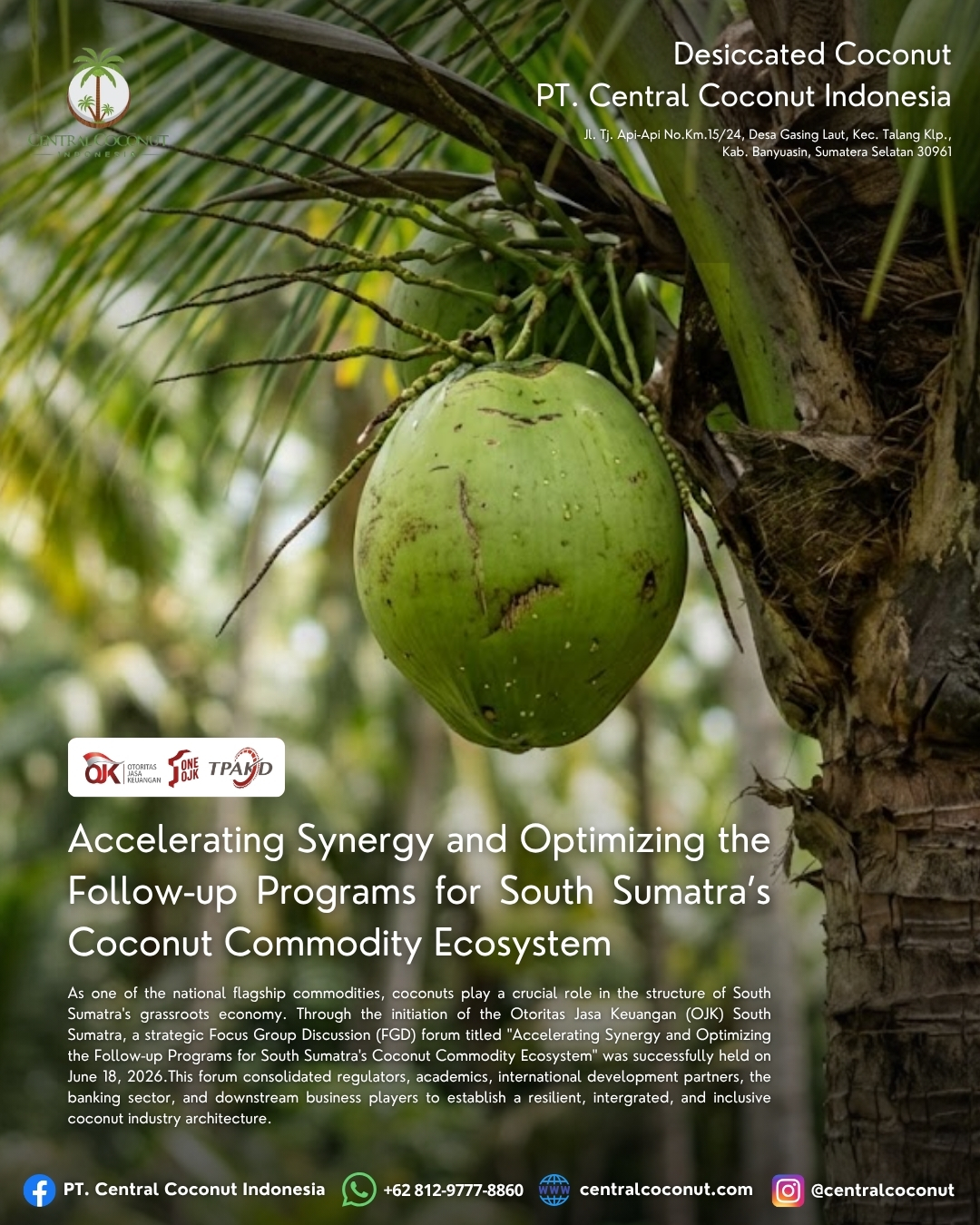
As one of the national flagship commodities, coconuts play a crucial role in the structure of South Sumatra’s grassroots economy. Through the initiation of the Otoritas Jasa Keuangan (OJK) South Sumatra, a strategic Focus Group Discussion (FGD) forum titled “Accelerating Synergy and Optimizing the Follow-up Programs for South Sumatra’s Coconut Commodity Ecosystem” was successfully held on June 18, 2026.This forum consolidated regulators, academics, international development partners, the banking sector, and downstream business players to establish a resilient, intergrated, and inclusive coconut industry architecture.
In his directive, the Head of OJK South Sumatra, Mr. Arifin Susanto, emphasized that the coconut commodity possesses extraordinary economic potential, backed by high regional productivity and a vast spectrum of downstream utilization. Unlike large estate plantations such as oil palm, which are dominated by corporations, the coconut industry in South Sumatra is predominantly managed by smallholders and micro to medium scale farmers. This characteristic carries deep socio economic implications, where strengthening this sector directly escalates the welfare of grassroots communities.
To mitigate conventional supply chains that tend to be unbalanced, OJK introduced a Closed Loop Ecosystem approach. This cloised ecosystem mode is designed to linearly integrate all value chain elements, starting from production input providers, farmers, and cooperatives acting as off takers, to processing industries financial service institutions. Through this interconnected system, structural barriers such as selling price uncertainty and limited working capital can be systematically eliminated.
OJK’s Role as a Financial Enabler: OJK is commited to facilitating expanded access to financing form upstream to downstream by utilizing innovative instruments, including Kredit Usaha Rakyat (KUR), KUR for Agricultural Machinery and Equipment, investment credit, working capital, and integrated supply chain financing schemes.
Empirical conditions on the ground indicate a national decline in the total acreage of coconut plantations from 2017 to 2024. Responding to this phenomenon, Mr. Ismail Maskromo from the Badan Riset dan Inovasi Nasional (BRIN) recommends utilizing Dwarf cocontu varietites (such as Genjah Entok Kebumen, Genjah Hijau Labuhan Batu, and Genjah Merah Bali), which offer investment advantages due to a significantly shorter pre-bearing period (1.5 to 2.5 years) compared to hybrid or Tall coconut varieties.
Beyond variety selection, the implementation of technology-driven precision agriculture (including the application of the Internet of Things/IoT) has been proven to boost land productivity by up to 30%. An intercropping approach during the immature plant phase is also offered as a tactical solution to generate periodic additional income for farmers.
Regarding regional empowerment, International Centre for Research in Agroforestry (ICRAF) Indonesia through the Land4Lives Program facilitated by Mr. Syamsul Asinar Radjam has conducted intensive assistance in coconut production hubs within Muara Sugihan Distric, Banyuasin Regency. ICRAF successfully institutionalized farmer learning groups and introduced Climate-Smart Agriculture practices. Through join research synergies with Sriwijaya University, coconut waste is converted into high value economic commodities such as biochar, liquid smoke, and cocopeat which simultaneously serve as a nature based solution for climate change mitigation.
The fundamental challenge of downstream expansion at the farmer level is the limited adoption of technology and a non commercial production sclale. Yet, value chain studies of the cooconut commodity indicate that all components of the coocnut plant meet the criteria to be processed without residue (a zero waste concept).
The future prospects of downstream processing in South Sumatra are currently shifting toward the global renewable energy industry. PT. Green Power Palembang is actively realizing the costuction of a Crude Coconut Oil (CCO) plant in Banyuasin Regency, which is projected to be operational by the second quarter of 2027. The plant, with a target capacity of 30,000 tons of CCO per year, is prepared to supply raw materials for international Sustainable Aviation Fuel (SAF) or bioavtur. This industry demands strict compliance with Carbon Offsetting and Reduction Scheme for International Aviation (CORSIA) certification standards, dictating that raw materials must be sourced from non food coconuts.
Formal financing barriers often stem from high fragmentation and weak legal standing among micro business players. Addressing this issue, Mrs. Tsania Putri (MCA Indonesia II) disseminated Millennium Challenge Account Indonesia II dissemenitaed the Micro, Small, and Medium Enterprises MSME Finance Project, a grant intiative from the United States Goverment (administered via MCC) aimed at bridging the financing gap or natioanl MSMEs through strategic commodity based approach. This value chain mapping is crucial to ensure that financial interventions occure as a logical consequence of a mature ecosystem, rather that mere capital injections without market certainty.
From a local regulatory perspective, the Head of the South Sumatra Province Cooperatives and UKM Department, Dr. Hj. Mega Nugraha, affirmed her institution’s readiness to support the industrial supply chain through an empowerment program targeting 3,258 Merah Putih Village/Koperasi Desa spread across 17 regencies/cities. Cooperatives will be optimized to act as commodity aggregators and consolidators of production volume. Regional banking institutions, including Bank Sumsel Babel, Bank Mandiri, Bank Negara Indonesia (BNI), Bank Rakyat Indonesia (BRI), Bank Syariah Indonesia (BRI), Permodalan Nasional Madani (PNM), stated their alignment of vision to reduce credit risk by channelling corporate based cooperative financing instead of individual loans.
As a concluding framework, representatives from Bank Indonesia, Mr. Bambang Pramono and the Regional Office of DJPb South Sumatra, Mr. Rahmadi Murwanto, emphasized the vital presence of the Local Government as the leading sector or chief ochestrator. Cross-sectoral synergies must be formally drafted into a comprehensive roadmap for the development of South Sumatra’s coconut commodity.
Accordingly, the 7 tactical policy recommendations agreed upon by the FGD participating institutions include:
- Optimizing the roles of technical departments (Plantations, Industry, Copperatives, Trade, Bappeda) in synchronizing cross sector programs sustainably.
- Drafting strategic proposals to request the utilization of estate crop restructuring funds from the Badan Pengelola Dana Perkebunan (BPDP) to support smallholder rejuvenation programs and farmer capacity building.
- Accelerating the establishment and standardization of village cooperative governance to act as the sole supply chain aggregator, thereby protecting farmer’s bargaining power.
- Strengthening the implementation of Closed Loop architecture to foster a competitive market and a bankable financing environment.
- Promotong the diversification of zero waste downstream industries to enchance local value added benefits and generate new employment opportunities.
- Urging the financial services sector to expand commercial financing protfolios through secure supply chain financing schemes that adpat to industrial risks.
- Implementing periodic coordination forums and scheduled business matching agendas to ensure all FGD commitments are realized accountably.
Published by:
Otoritas Jasa Keuangan in Forum Group Discussion “Akselerasi Sinergi
dan Optimalisasi Program Lanjutan Ekosistem Komoditas Kelapa Sumatera
Selatan”.
Briandy Effendi
Sales Executive
WhatsApp: +62 812-9777-8860 | E-Mail: sales@centralcoconut.com
Jl. Tj. Api-Api No.Km.15/24, Desa Gasing Laut, Kec. Talang Klp.,
Kab. Banyuasin,