In the food manufacturing, bakery, and confectionery industries, Desiccated Coconut is no longer viewed as just a decorative topping or a visual enhancement. It has evolved into a vital functional ingredient that directly influences texture, aroma, shelf life, and overall production costs.
However, when reviewing technical specifications from suppliers, you will inevitably face a critical classification: High Fat vs Low Fat.
Choosing the wrong category does more than just throw off your product’s flavor profile, it can compromise dough stability and ruin your formulation on the production line. Let’s break down the scientific and practical differences between the two so you can select perfect match for your product matrix.
From a technical standpoint, the fundamental difference between these two variants lies in whether or not the coconut meat undergoes an extraction process prior to dehydration.

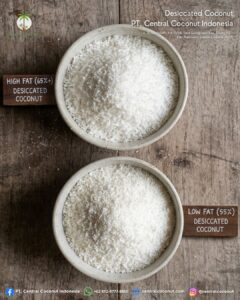
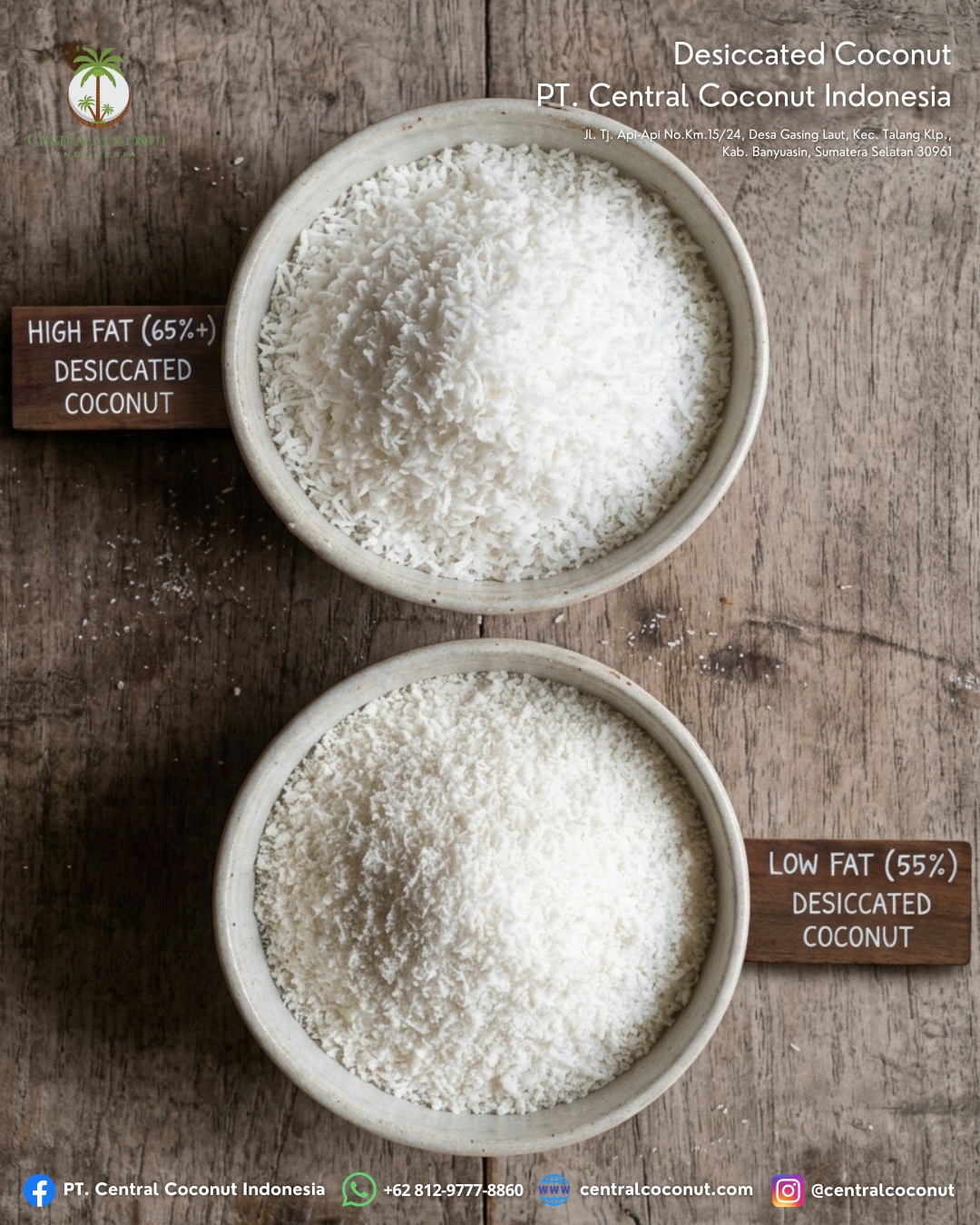
High Fat Desiccated Coconut (HFDC)
- Minimum 65% (typically ranging between 65% – 68%)
- Fresh coconut meat is shredded and dried directly. The natural oils (inherent Virgin Coconut Oil) remain entirely intact within the fiber matrix.
- Delivers an intense, distinctively milky and nutty coconut aroma, a rich and savory flavor, and a tender moist mouthfeel upon mastication due to its rich oil content.
Low Fat Desiccated Coconut (LFDC)
- Generally below 50% (with some industrial grades requiring it to be below 40% or even 30%)
- The coconut meat is pressed or centrifuged first to extract coconut milk or oil. The remaining fibrous cake is then dried.
- Features a much subtler, milder aroma, a relatively neutral flavor, and a highly dry, significantly more fibrous texture.
In food science, fat serves as both a shortening agent and a flavor carrier. Here is how varying fat levels manipulate your products formulation:
Moisture Retention & Control
- High Fat is the natural lipids in HFDC act as an effective moisture barrier. In baked goods like cookies or biscuits, HFDC helps lock in internal moisture, resulting in a product that remains soft and chewy on the inside yet crisp on the outside.
- Low Fat due to its minimal fat content, the fiber in LFDC is highly hydrophilic (water-loving). If incorporated into a dough matrix without adjusting the formula, it will aggressively absorb water or liquids from your recipe. This often yields a crumbly, dry, and brittle end-product post-baking.
Shelf Life & Rancidity (Oxidative Stability)
- High Fat, high lipid content inherently increases susceptibility to lipid oxidation if improperly stored. When exposed to ambient air and heat, HFDC faces a higher risk of rancidity. Consequently, formulations utilizing HFDC require high-barrier packaging to mitigate oxygen exposure.
- Low Fat, with minimal oil content, LFDC exhibits superior oxidative stability against rancidity. Its shelf life under standard storage conditions is remarkably consistent regarding aroma and flavor preservation.
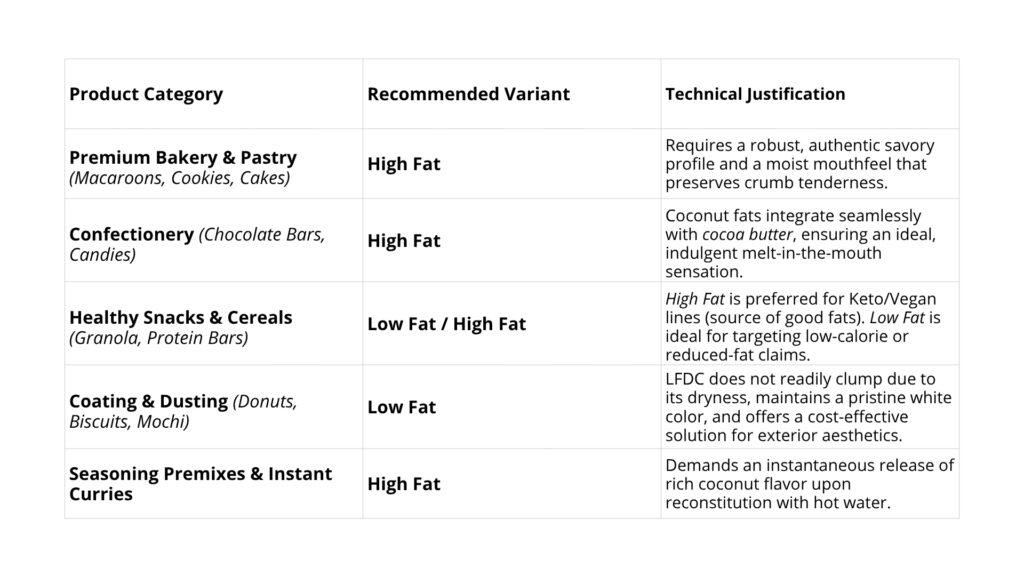
To assist your Research and Development (R&D) team, here is a strategic application matrix for each type.
From a purchasing and cost-management perspective, Low Fat Desiccated Coconut typically commands a lower unit price in the market, as its initial value is offset by the revenue generated from the extracted milk or oil.
However, procurement strategies should look beyond the raw material cost per kilogram. If your product line demands a potent, authentic coconut flavor profile, subsituting with cheap LFDC can backfire economically. You may find yourself forced to add artificial coconut flavors or enchancers to meet sensory benchmarks, diriving up overall formulation costs.
Coversely, by leveraging High Fat Desiccated Coconut, you secure the authentic taste, aroma, and texture organically from a single, clean-label ingredient.
There is no absolute “superior” choice; rather, there is only the right fit for your target product specs
- Opt for High Fat Desiccated Coconut if your product’s key performance indicators (KPIs) are flavor authenticity, premium aroma, rich moutfeel, and the functional benefits of natural fats within the dough.
- Opt for Low Fat Desiccated Coconut if you are targeting cost efficiency for exterior coatings, require exceptional oxidative stability, or are formulating low-calorie dietary foods.
Prior to running full-scale production trials, always consult the Certificate of Analysis (CoA) from your supplier to ensure the precise fat content and moisture levels pefectly align with your quality control standards.
Briandy Effendi
Sales Executive
WhatsApp: +62 812-9777-8860 | E-Mail: sales@centralcoconut.com
Jl. Tj. Api-Api No.Km.15/24, Desa Gasing Laut, Kec. Talang Klp.,
Kab. Banyuasin,